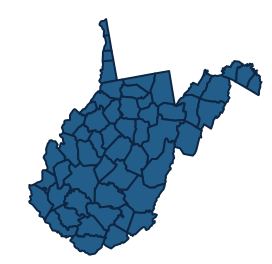
Elections
Marion County, WV, has approximately 40,000 registered voters as of 2024, with 45% Democrat, 30% Republican, and 25% unaffiliated/other. The county administers local, state, and federal elections, with 29 polling locations. In the 2022 general election, voter turnout was 43%. Recent issues include school levies and infrastructure bonds. Election administration is managed by the Marion County Clerk. Democrats historically lead local offices, but Republicans gained ground in recent cycles. Early voting and absentee ballots are also available, enhancing accessibility for voters.
Education, Employment and Housing
Marion County, WV, serves around 8,300 students in 22 public schools, including 3 high schools. Approximately 84% of adults hold a high school diploma, while 21% have a bachelor’s degree or higher. Average graduation rates exceed 88%, and schools have a GreatSchools rating average of 6/10. Extensive programs cover STEM, vocational training, and dual-credit college courses. Adult education is supported via the Marion County Adult & Community Education Center. School safety initiatives include SROs and an 8:1 student-counselor ratio, fostering secure learning environments across the county.
As of 2023, Marion County, WV, has an employment rate of approximately 54%, with a labor force participation rate of 55%. The largest industry is health care and social assistance (16.5%), followed by retail trade (13.7%) and educational services (10.4%). Leading occupation types include office/administrative support (12%), sales (10%), and production (9%). Around 84% of employed residents commute by car, with an average commute time of 23 minutes, and 73% work within Marion County, while others commute primarily to Monongalia and Harrison counties.
Marion County, WV reports a homeownership rate of about 73% and a median home value of $126,000 as of 2023, with median rent around $775 monthly. The property market has seen modest price increases of roughly 3% year-over-year. Housing types range from historic single-family homes in Fairmont and Rivesville to newer suburban developments and apartment complexes. Popular neighborhoods include Fairmont’s Oakwood and Morgantown Avenue areas. Property taxes are relatively low, averaging $600–$900 annually for most homeowners, contributing to the area’s affordability.
County Crime & Safety
Marion County, WV, reported a crime rate of approximately 19.7 per 1,000 residents in 2022, below the national average. Violent crime remains relatively low, with about 2.4 incidents per 1,000 people, while property crime accounts for 17.3 per 1,000. The Marion County Sheriff's Department and Fairmont Police actively monitor and report crime data, emphasizing community policing. Recent trends indicate stable or slightly declining crime rates, supported by increased neighborhood patrols and public safety initiatives. Overall, Marion County is considered moderately safe compared to state and national statistics.
Demographics
As of the 2020 Census, Marion County, WV, had a population of approximately 56,205. The median age was 42 years. Females comprised about 51% of residents, and males 49%. The racial composition was predominantly White (92%), with Black or African American (3%), two or more races (3%), Asian (0.6%), and Hispanic or Latino (1.2%). Overall, Marion County reflects the demographic trends of many rural West Virginia areas—aging, with minimal ethnic diversity.
Popular names
- Michael Moore
- James Jones
- James Moore
- John Jones
- John Martin
- Robert Jones
- Robert Tennant
- Amanda Shaffer
- James Toothman
- James Wilson
- Jennifer Wilson
- Robert Davis
- Robert Thompson
- Robert Wilson
- Amanda Wilson
- Brenda Moore
- Charles Davis
- Charles Moore
- Cody Wilson
- David Jones
- James Davis
- James Shaver
- James Smith
- James Stewart
- John Williams
- Matthew Smith
- Patricia Martin
- Raymond Martin
- Robert Michael
- Robert Moore
- Robert White
- Thomas Moore
- Brenda Martin
- David Haught
- David Smith
- David Williams
- Donald Jones
- James Jenkins
- James Phillips
- Jimmy Shepphard
- John Johnson
- John Myers
- John Toothman
- John Wilson
- Joshua Davis
- Kenneth Satterfield
- Michael Jones
- Richard Toothman
- Robert Stevens
- William Johnson
- April Smith
- Barbara Miller
- Brian Martin
- Brian Wilson
- Charles Carpenter
- Charles Miller
- David Eddy
- David Moore
- Deborah Davis
- Donna Davis
Other Counties in West Virginia
- Barbour
- Berkeley
- Boone
- Braxton
- Brooke
- Cabell
- Calhoun
- Clay
- Doddridge
- Fayette
- Gilmer
- Grant
- Greenbrier
- Hampshire
- Hancock
- Hardy
- Harrison
- Jackson
- Jefferson
- Kanawha
- Lewis
- Lincoln
- Logan
- Marshall
- Mason
- Mcdowell
- Mercer
- Mineral
- Mingo
- Monongalia
- Monroe
- Morgan
- Nicholas
- Ohio
- Pendleton
- Pleasants
- Pocahontas
- Preston
- Putnam
- Raleigh
- Randolph
- Ritchie
- Roane
- Summers
- Taylor
- Tucker
- Tyler
- Upshur
- Wayne
- Webster